
From buying keywords to buying outcomes: where the edge is on Google now

-
Part 1 of our "Buying outcomes" series. Part 2 covers Meta.
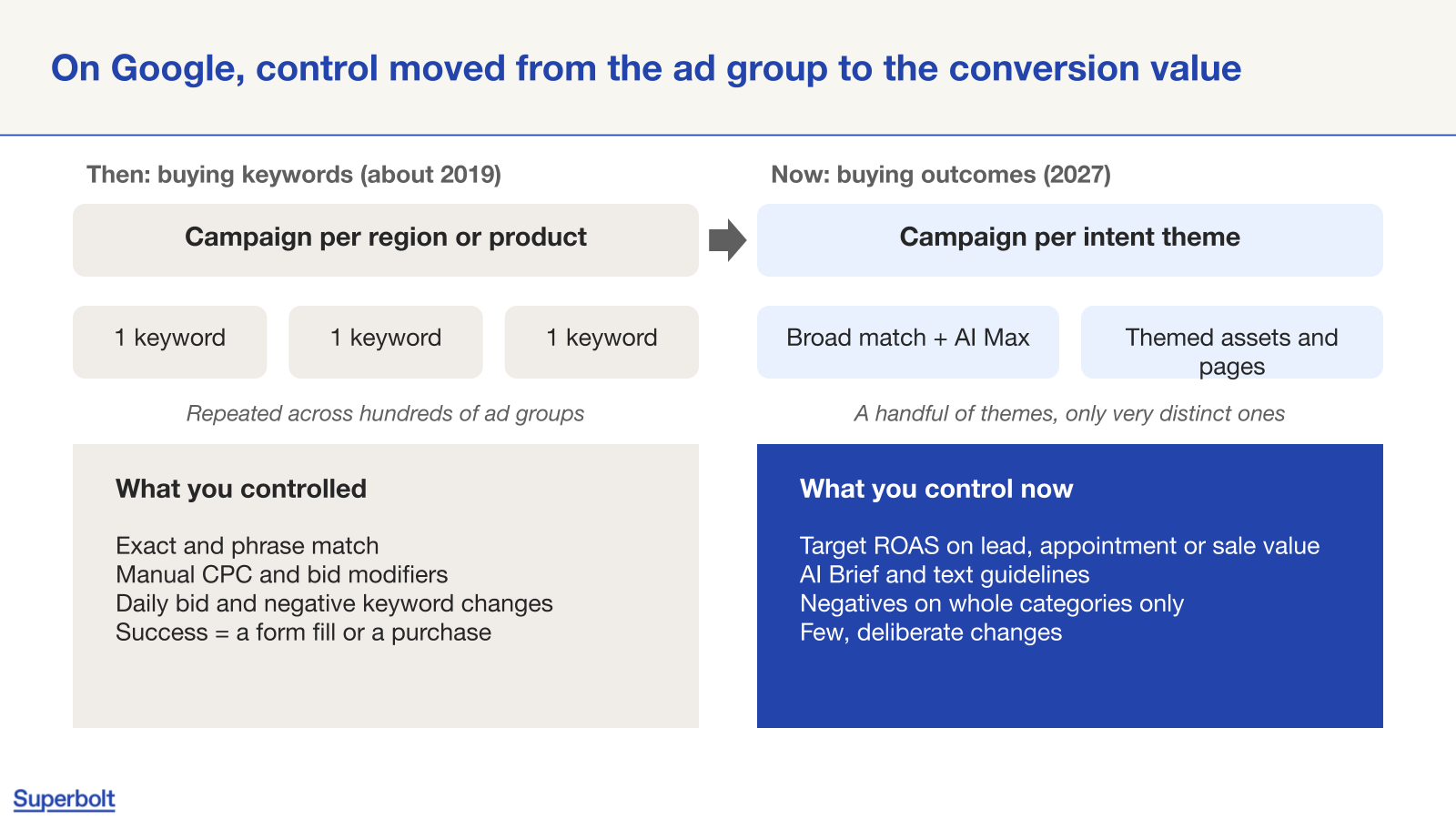
In 2019, a best-in-class Google Ads account had hundreds of ad groups with one keyword each, exact match almost everywhere, and a media buyer adjusting bids every morning. It was a craft and I remember one of our early Google Ads specialists talking about his work like a craftsman talks about his craft.
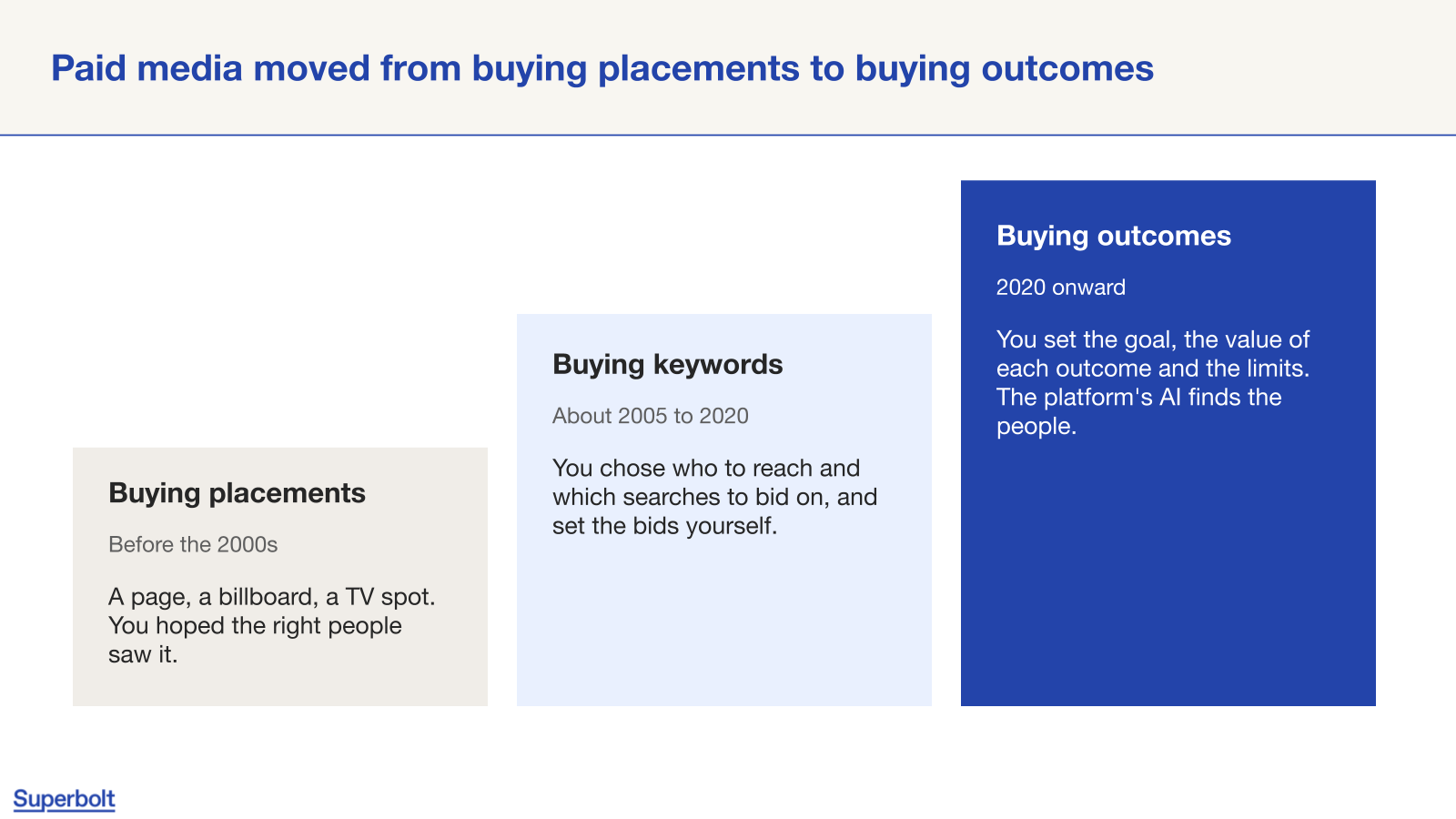
However, today that same approach and these types of structures work against you. In an audit we ran in January for a home services client, we shared that granular controls get "rendered useless when the platform is continuously destabilized and lacks the right data inputs." That sentence sums up five years of change on Google. Advertisers no longer buy keywords. They buy outcomes, and Google's AI decides which searches get them there.
This article covers what changed, what Google launched in 2026 that points the same way, which controls you still have, and where we see higher returns coming from in the accounts we manage.
-
-
The SKAG era, and why it worked
The single keyword ad group (SKAG) was the best practice from roughly 2014 to 2020. One keyword per ad group, in exact and phrase match, with an ad written for that exact query. Bids were set manually or with enhanced CPC, and bid modifiers by device, hour and location did the fine-tuning.
The media buyer worked like a day trader: search term report, new negatives and bid changes every morning. And it worked, for three reasons:
- Exact meant exact. A keyword matched the query you chose and very little else.
- Quality Score rewarded tight relevance. An ad written for one keyword earned a better score and a cheaper click.
- The algorithms had little to work with. Human segmentation added information the system did not have.
None of these three conditions holds anymore.
-
What changed
Close variants loosened match types, so exact match stopped meaning exact. Smart Bidding became the default, and Google started recommending broad match paired with Smart Bidding. Performance Max brought buying across all of Google's inventory in one campaign, and AI Max brought keywordless matching to Search itself.
At the same time, the queries changed. With AI Overviews and AI Mode, people type longer, more conversational searches. Across our clients, paid search clicks grew 13% from January to September 2026 compared with the same period in 2025, with more words per search. No keyword list covers that.
The consequence is simple: every split divides the data the bidder learns from. Two hundred ad groups with three conversions each are noise to Smart Bidding. So we now organize campaigns by intent theme rather than by keyword, keep only the segments that are truly different, and spend the time this frees up testing Google’s new features early, while they still give an edge.
-
-
2026: most new features point the same way
Google’s 2026 ad launches (many announced at Google Marketing Live in May) read like a list of answers to one question: how do we get better inputs from advertisers?
- AI Max for Search and Shopping: keywordless matching on Search, and Shopping ads that answer conversational queries from your Merchant Center feed.
- AI Brief (rolling out on an allowlist): you steer the AI in plain language on what ads should say, which searches to capture or avoid, and how to speak to each audience, with the reason behind each rule.
- Journey-aware bidding (beta): Target CPA learns from conversions you could not bid on before, such as calls and form fills.
- Smart Bidding Exploration extended to Shopping and Performance Max, and demand-led pacing, which spends more on peak days without going over your total budget.
- Ads in AI Mode and Business Agent for leads, where the ad itself answers a prospect's questions.
- Asset Studio, where you can upload brand guidelines that Google keeps as a permanent reference for generated creative.
- Measurement built around value: Lead Journey Mapping, Qualified Future Conversions, Meridian GeoX for geo experiments, and uplift experiments for Demand Gen.
Read together, Google wants better inputs from advertisers, not more hands-on management.
-
The new controls with most impact
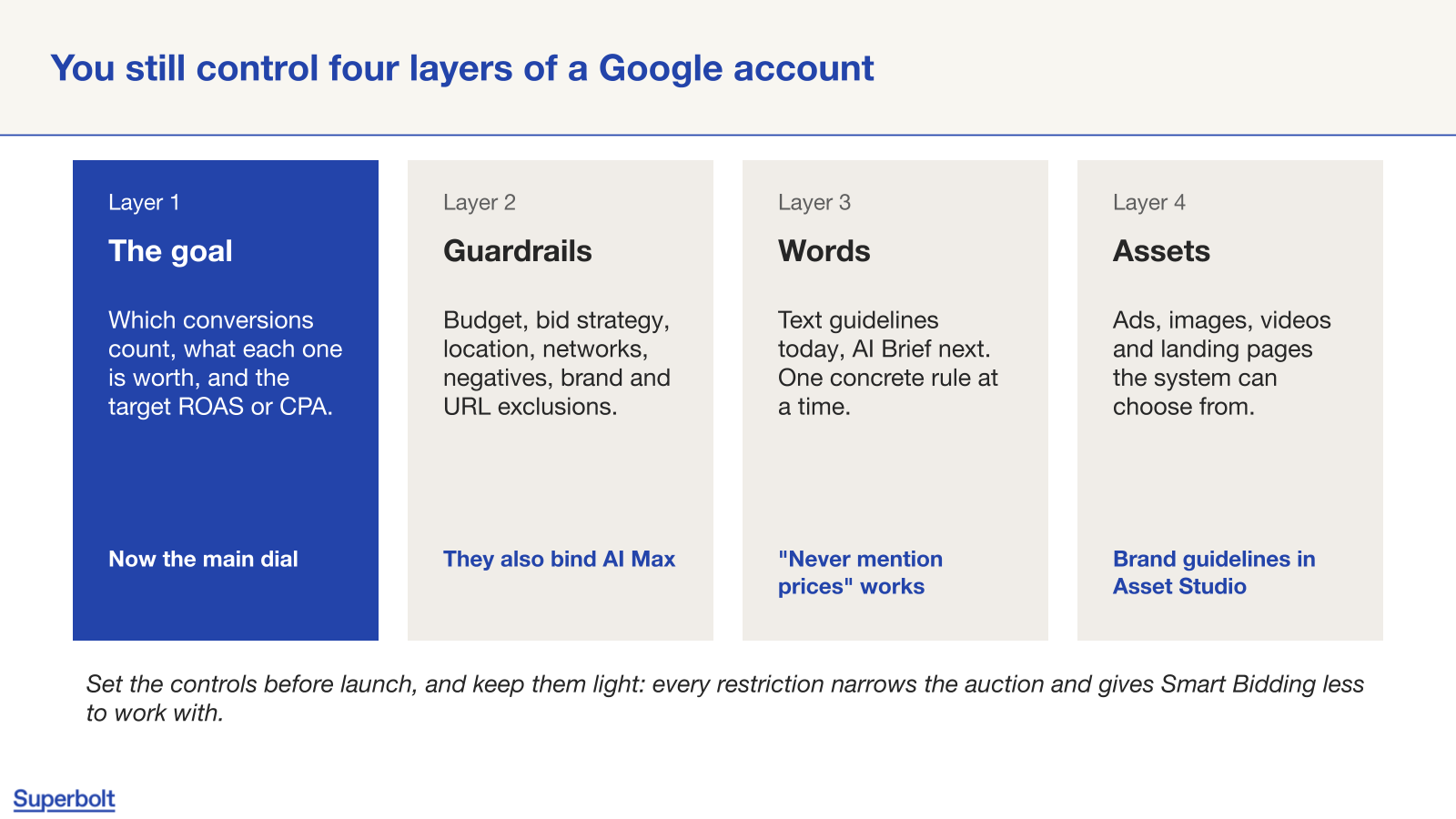
Buying outcomes does not mean giving up control. The controls moved. We think of them in four layers:
- Goal: which conversions count, what each one is worth, and the target you set (tROAS or tCPA). This is now the main directional dial for Google.
- Guardrails: budget, bid strategy, location, networks, negatives, and brand or URL exclusions. Every guardrail set at campaign level also binds AI Max.
- Words: text guidelines today, AI Brief next. Write them one rule at a time, and be concrete. "Never mention prices" works; "our ads should bring joy" does not.
- Assets: the ads, images, videos and landing pages the system can choose from, and that teach it what the brand looks and sounds like.
Two pieces of guidance from Google match what we see. First, don't over-control: every restriction narrows the auction and gives Smart Bidding less to work with. Second, set your controls before launch, not after.
What to stop doing: a high daily volume of changes, keyword sculpting at the ad group level, and regional splits when each region has too little signal to learn from.
-
-
Where higher returns come from now
When we audit a Search account, we score five levers by impact. Here is how we rank them for 2027.
1. Signal quality and depth
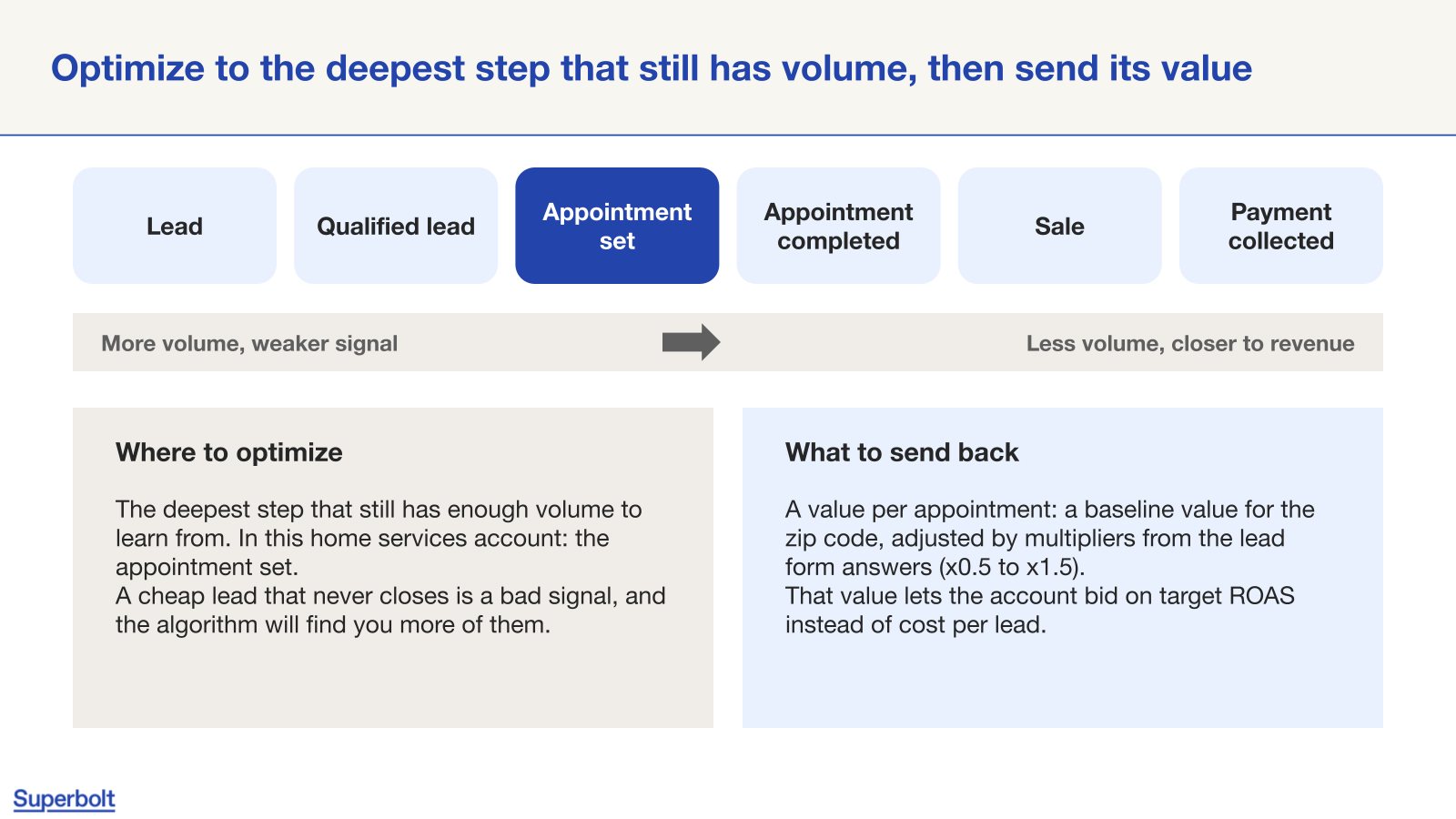
This is the biggest lever, and it is a data and operations project more than a media project. Optimize to the event closest to revenue that still has enough volume, then tell Google what each conversion is worth.
For the home services client above, the path had three steps. First, we sent CRM outcomes back as offline conversions, so Google saw appointments and not only form fills. Second, we turned the lead form answers into a lead value, the way an ecommerce brand uses order value. Third, we built an appointment value from an average value per zip code, adjusted with multipliers based on how leads with similar answers converted in the past. That value lets the account run on target ROAS, and it handles the location differences that used to require separate regional campaigns.
For ecommerce, the same idea applies with product value adjustments and, where you can share it, margin instead of revenue.
-
-
2. Intent architecture
Campaigns by keyword theme, broad match with AI Max, and negatives applied to whole categories rather than to individual queries. Keep a separate campaign only when the intent, the landing page or the economics are truly different.
3. Context
Someone on the team should own the AI Brief and the text guidelines, and keep them current as offers and products change. It is a new job, and in most teams nobody has it yet.
4. Creative and landing pages
Asset Studio makes it easier to produce on-brand variations. Once Quality Score best practices are in place, conversion rate work on the landing page is usually the next lever.
5. Change discipline and measurement
Fewer, bigger and deliberate changes, with time to read each one. And measurement that fits the spend: Demand Gen should be judged on conversion lift, not last click. Until a lift test proves it, we keep it to a small share of the budget.
-
Self-audit: five questions
- Does Google know what a good conversion is worth, or only that it happened?
- How many of your campaigns get fewer than 30 conversions a month?
- Who wrote your AI Max text guidelines, and when were they last updated?
- How many changes did the account see last week, and which ones mattered?
- How do you measure the spend that doesn't show up in last click?
The best accounts we manage in 2026 don't have the most controls. They have the best inputs: lower-funnel conversion values, a curated list of intent themes, and inputs that tell Google who the brand is. In Part 2, we look at how the same shift is playing out on Meta, where the October 2026 ranking announcement takes it one step further.
Get in touch with us.
We are headquartered in New York.
New York City
225 Broadway, Floor 41
10007