
AI in the modern ad creative process
-
How AI helped us meet creative diversity requirements on Meta
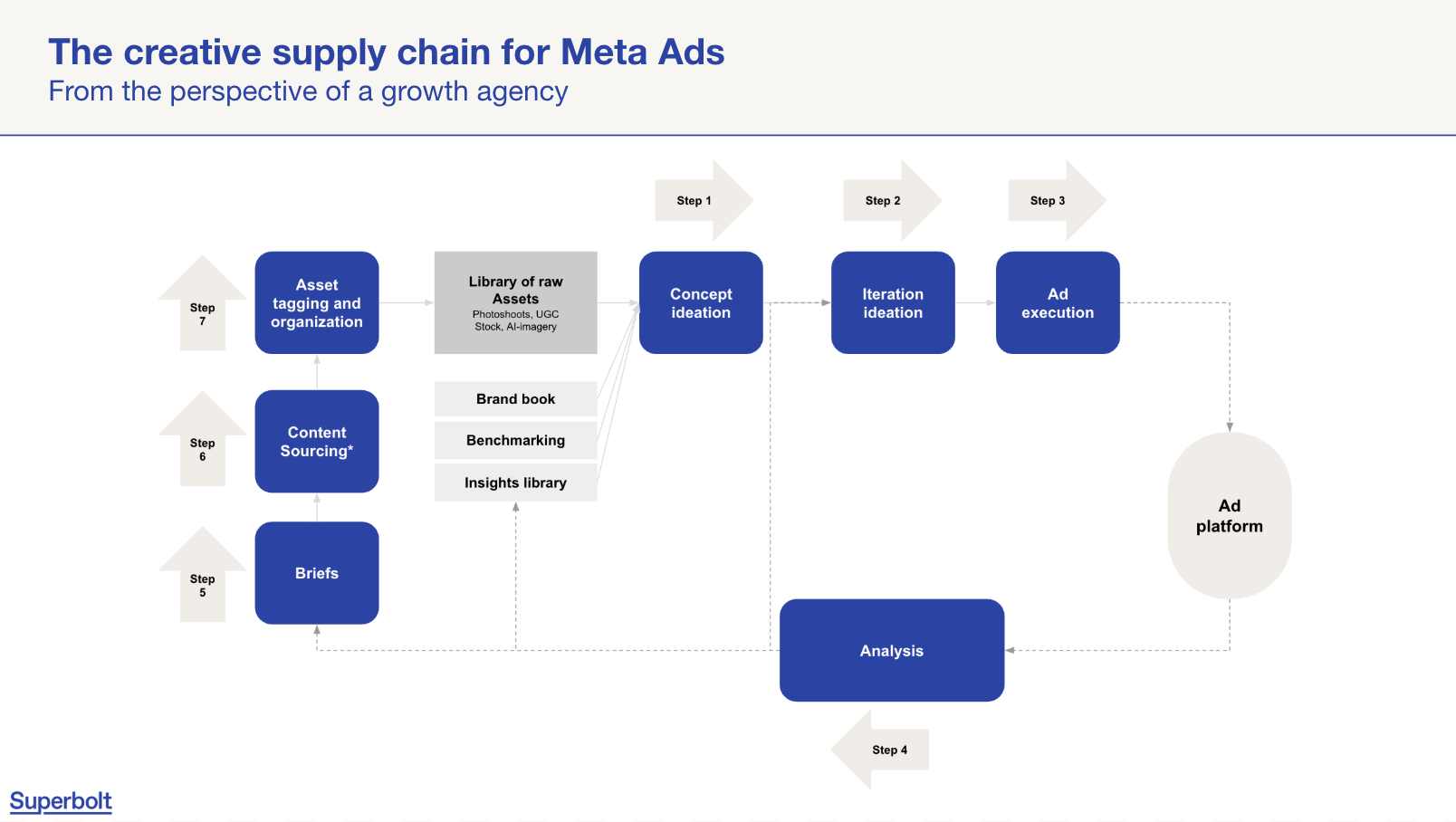
In our previous article, we argued that winning on Meta post-Andromeda is not necessarily about making more ads, but about building a creative supply chain capable of delivering real diversity at scale. The challenge is that this new reality requires roughly twice the creative output most teams were used to producing.
Over the past 12 months, we’ve managed to roughly double our creative volume for clients without doubling headcount. The main lever has been a pragmatic, production-focused use of AI across our creative supply chain. In the end, we see AI as a force multiplier for our creative team (not a replacement for their creativity and judgement)
-
Two layers of AI in the creative workflow
We’ve deployed AI in two complementary ways:
-
1. AI features inside best-in-class tools
The first layer is leveraging AI that already exists inside great products our teams use every day.
For example, AI-powered hook and variation engines help us quickly generate new angles on existing winning concepts. Instead of starting from a blank page, teams start from a strong baseline and expand outward. This increases the speed and breadth of ideation for iterations, which is critical when performance requires constant creative refresh.
Similarly, AI auto-tagging inside asset management tools has transformed how we search and reuse our creative libraries. Assets are automatically labeled by visual and semantic attributes, making it dramatically easier for both humans and machines to find the right building blocks for a new concept or variation.
These capabilities don’t create finished ads. They remove friction in the early steps of the supply chain or with ideation.
2. Custom AI agents built on top of foundation models
The second layer required more than just giving ChatGPT access to the team.What we found is that for tasks like creative brainstorming or creative analysis, generic AI is rarely usable out of the box. To be effective, it needs:
- Deep client context (brand guidelines, past assets, performance data, competitive benchmarks)
- Clearly defined, repeatable tasks it is designed to perform
So we built custom AI agents that sit on top of large language models but are wired into our internal systems and processes. Two examples illustrate how this works.
-
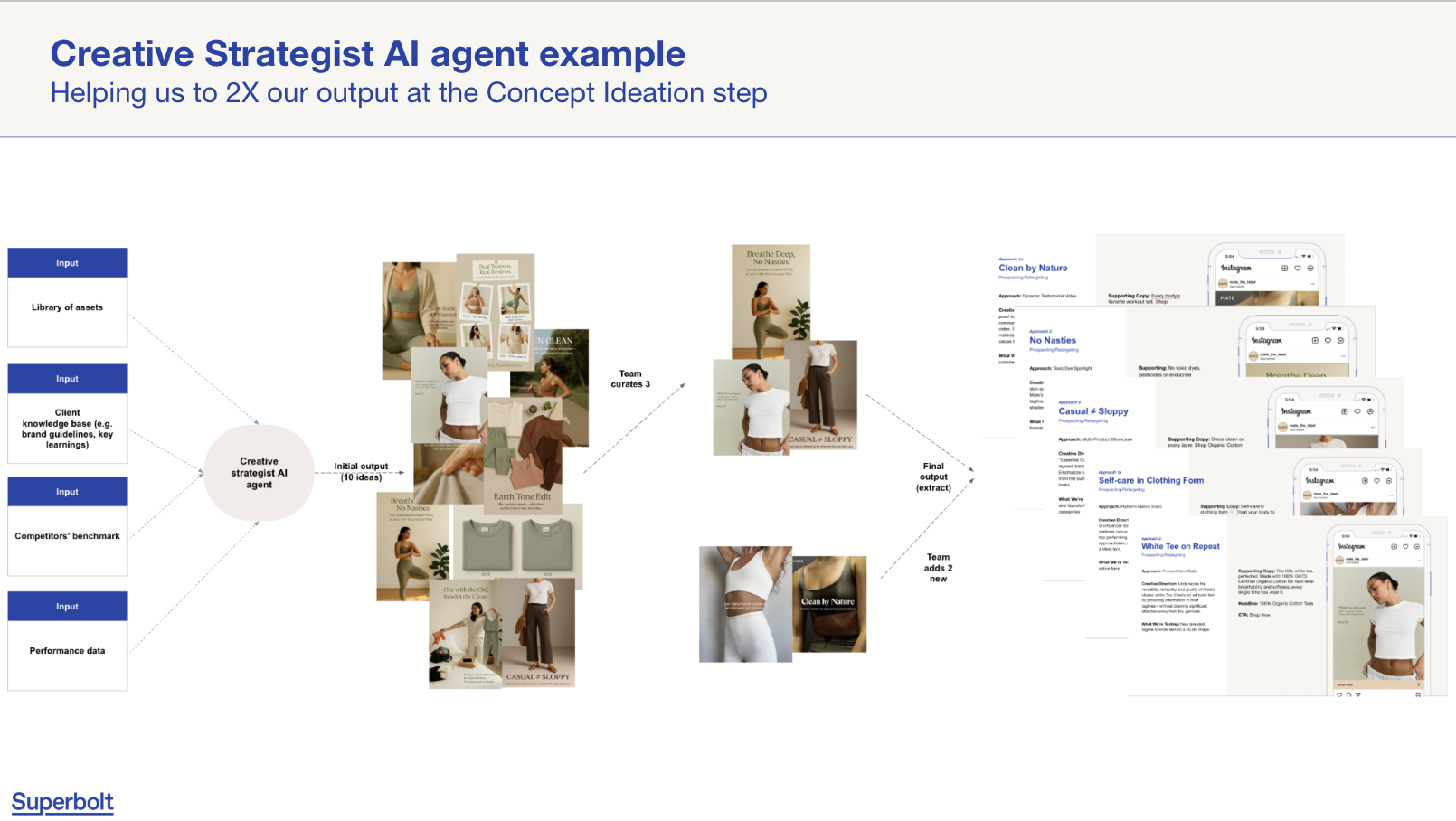
Example 1: The Creative Strategist Agent
This agent focuses on concept ideation.
It ingests:- A library of existing assets
- Client knowledge bases and brand rules
- Competitor benchmarks
- Historical performance data
From this, it generates a first batch of concept territories, hooks and visual directions. As illustrated in our internal workflow, the agent produces an initial large set of ideas which the team then curates, refines and expands into final concepts ready for production. That alone roughly doubles output at the ideation step.
-
-
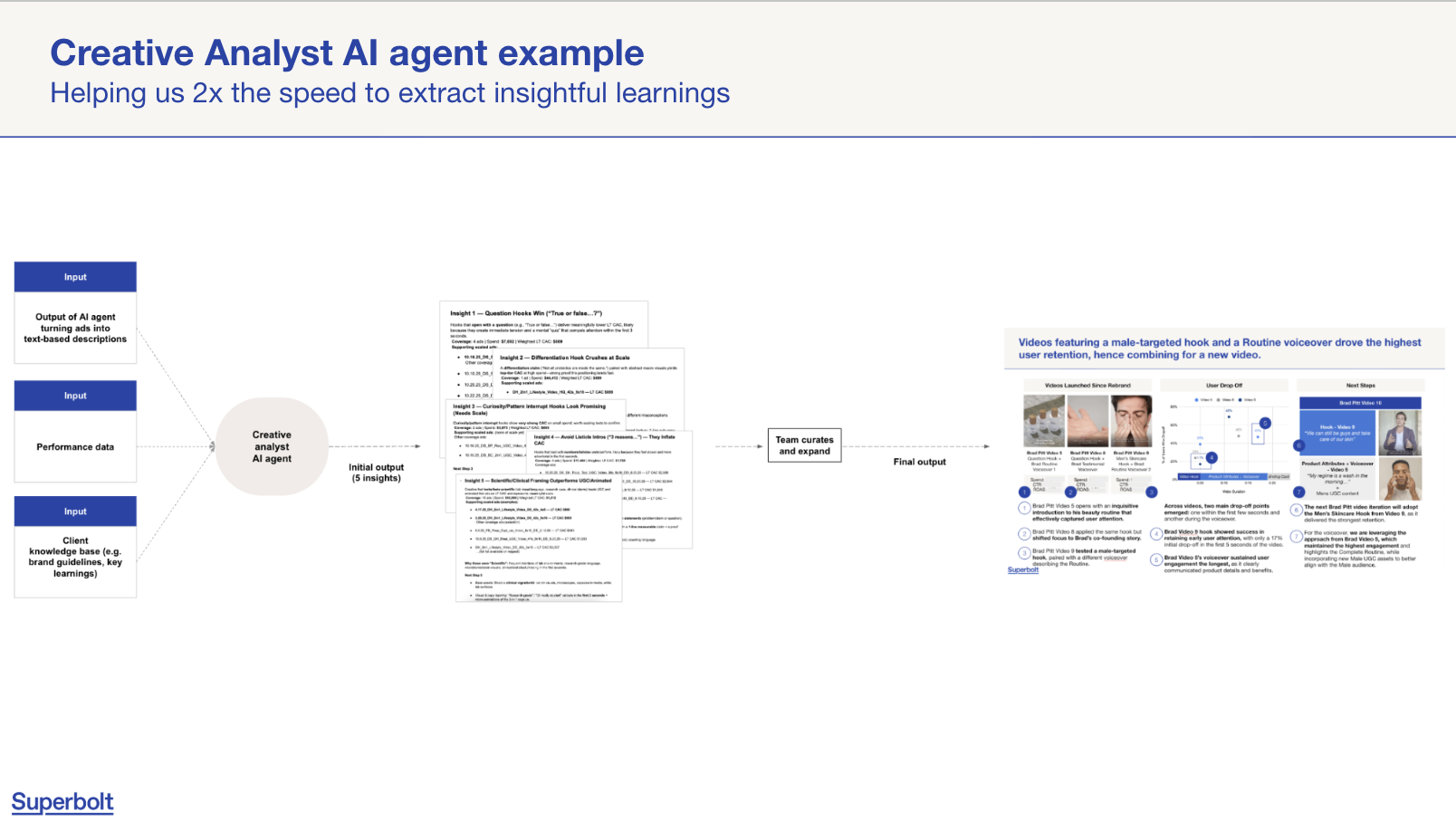
Example 2: The Creative Analyst Agent
The second agent focuses on learning extraction. Instead of manually reviewing dozens of ads and spreadsheets, the agent takes:
- Structured performance data
- AI-generated descriptions of each creative
- Client and brand context
It produces an initial set of prioritized insights and hypotheses about what is driving performance. The team then validates, edits and expands those insights into actionable recommendations and briefs, as shown in the analysis workflow. This cuts the time to get from “data” to “clear creative direction” roughly in half
-
-
AI often accelerate early steps, Humans are always the final authority
Across both use cases, the pattern is the same. AI agents take the first pass at:
- Generating options
- Structuring information
- Surfacing patterns
Humans take the final pass at:
- Applying taste and brand judgment
- Making trade-offs
- Turning outputs into production-ready work
The result is not fewer people doing the same amount of work. It’s the same people able to do about twice as much meaningful work for clients.
-
Why This Matters for the Modern Creative Supply Chain
Post-Andromeda, the bottleneck in Meta performance is almost always upstream of the ad account. It sits in the system that turns insights into new, diverse creative.
AI helps us relieve pressure at two critical points in that system:
- Concept generation (more high-quality starting points)
- Learning extraction (faster, clearer feedback loops)
-
By accelerating both ideation and analysis, AI increases the throughput of the entire creative supply chain without sacrificing quality or brand integrity. That is what has allowed us to double creative output over the last year. Not by asking teams to work twice as hard, but by giving them tools that make each hour count twice as much.
In a world where winning on Meta requires roughly twice the creative diversity of the pre-Andromeda era, building that kind of leverage became a necessity to maintain performance for fast growing brands.
Get in touch with us.
We are headquartered in New York.
New York City
225 Broadway, Floor 41
10007